Does Your Resume Stand Up to the Competition?
Curt Skene’s In2Win! Career Coaching Supplement.
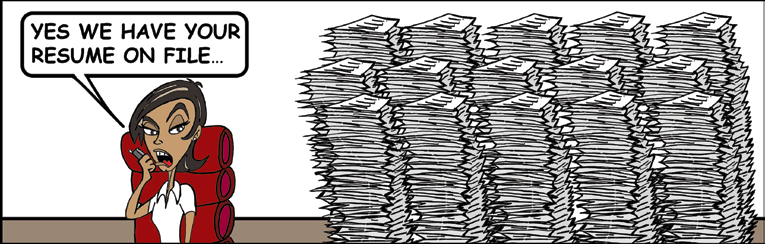
Imagine that for every opportunity there is a minimum of one hundred candidates vying for that position. Now ask if your resume will be near the top. When reviewing your resume the hiring manager typically makes a decision on the first page. After that they are reading the rest to justify the opinion they have already formed. Take a hard look and make sure your highlights and capabilities are all listed on top. Much like a celebrity magazine, your goal is to entice the employer early into wanting to learn more about you.
Go through every line and assure yourself if it has earned the right to be there. Are you speaking of results? Have you provided good context? Is the information clear and captivating? Will the employer care? Employers often look for alarming date patterns.
If there are short stays or gaps, then explain them. Never use date trickery (e.g. just providing the year employed) to try to fool an employer. Doing this will penalize you and get your resume eliminated quickly. Think about it; if you can’t be upfront at this stage what are you saying about the type of employee you will be?
Other experts will tell you to present your achievements in STAR format (Situation-Task-Action-Result); I suggest you reverse it and give them RATS (Result-Action-Task-Situation). The reason is simple… no one cares what you did until they know what results were achieved. Today, executive resumes include graphs and testimonials to draw the reader in and offer proof of capability.
A résumé matters, but strong perceived value can outweigh an imperfect document. Build value throughout the relationship.
Why I Wrote This Page
Because people weight what they read first far more heavily than what follows. For most practical purposes, your resume’s first page is your resume, since a lasting impression usually forms before a hiring manager finishes reading it.
This is the primacy effect, well documented in how people process information: the earliest details in a sequence get remembered and trusted more than later ones, even when the later details are just as important. That’s why burying your strongest results on page two doesn’t just delay the impact, it often means they never really register at all.
Leading with results instead of duties isn’t just a stylistic preference. It’s working with how attention and memory actually function, not against them.
Action Steps
- Put your strongest, most quantifiable result in the top third of page one. Don’t save your best material for later.
- Read only your first page as a stranger would, and ask if it alone would earn you a callback.
- Rewrite your top bullets in result-first order, what happened, then what you did to cause it, instead of duty-first order.
In2Win! Afterthought
Curt’s current observations and updated guidance will be added here.
Suggested Reading Links
The Learning Library contains hundreds of books on a variety of business and career topics. We want to make sure you don’t miss these ones.
What does this page mean for your search?
Share an idea, ask a question or learn from other In2Win! members. Posting requires a Quickstart, Premium or VIP login.
Be the first to join this discussion
Join the Discussion →